Posts

Showing posts with the label Mercedes-Benz

Why the eCitaro G fuel cell bus is the best choice for low-emission public transport
Image
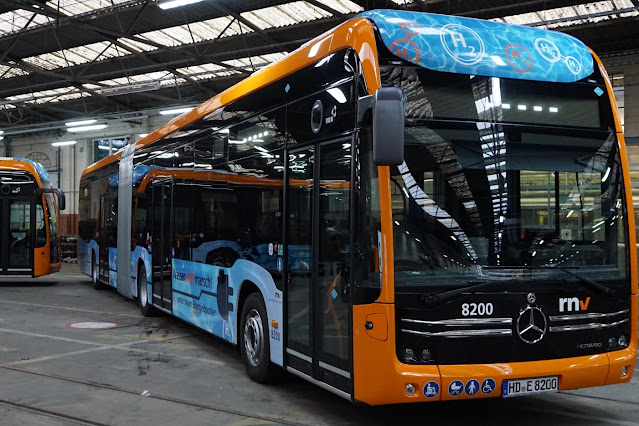
  Mercedes-Benz has recently delivered the first three of 48 fully electric eCitaro articulated buses with a 60 kW fuel cell as a range extender to Rhein-Neckar-Verkehr GmbH (rnv), a public transport operator in the Rhine-Neckar region of Germany. These buses are the world’s first series-production vehicles of their kind, and they offer a range of up to 400 kilometers on one charge, making them ideal for urban traffic in Mannheim and Heidelberg. What are the benefits of fuel cell buses? Fuel cell buses use hydrogen as an alternative fuel to electricity, which can be generated from renewable sources such as water electrolysis. Unlike battery-electric buses, which need to be recharged at charging stations, fuel cell buses can refuel at hydrogen stations, which are more widely available and convenient. Fuel cell buses also have a longer range than battery-electric buses, which means they can cover more distances without stopping. Fuel cell buses have several advantages over battery-el...
Celebrating 25 Years of the Mercedes-Benz Atego: A Versatile, Efficient, and Sustainable Truck for Distribution Haulage

Image
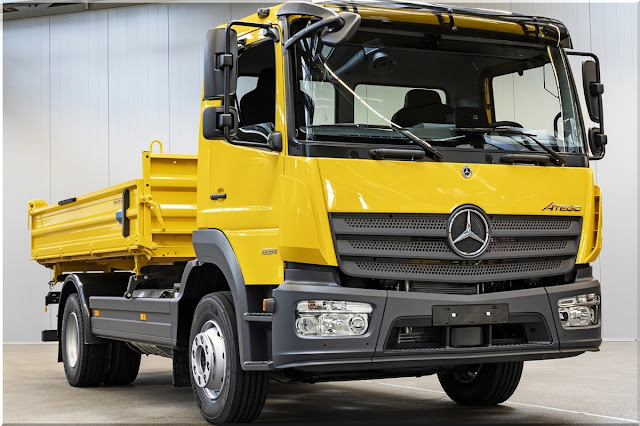
  The  Mercedes-Benz Atego  is a versatile truck that can handle a variety of transport tasks in distribution haulage. It has been on the market for 25 years and has gone through several generations of improvements and innovations. It has also won several awards, including the  International Truck of the Year  twice and the  German Sustainability Award . In this article, we will look at the history, achievements, and innovations of the Atego and why it is still a popular choice for many customers. The Atego's Debut in 1998 The Atego was introduced by  Daimler-Benz AG  in 1998 as a successor to the LK model series. It was designed to cover the segment with a permissible gross mass of between 6.5 and 15 tonnes and offer a high customization level for different applications. The Atego initially offered 25 basic types, six power output categories, and four cab variants. The engines were either four-cylinder or six-cylinder diesel units, with outputs r...